Mars Sample Return Mission Explained: Bringing Mars to Earth
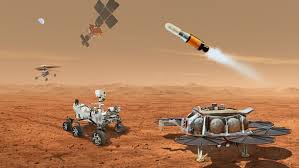
The Mars Sample Return (MSR) mission is one of the most ambitious scientific projects ever attempted. Led jointly by NASA and the European Space Agency (ESA), the mission aims to bring pristine samples of Martian rock and soil back to Earth for the first time in history.
While robotic missions have transformed our understanding of Mars, returning physical samples is considered the definitive step in determining whether life ever existed on the Red Planet.
The Mars Sample Return mission builds directly on the work of NASA’s Perseverance rover. If you want a detailed explanation of how those samples are collected and why the rover was sent to Jezero Crater, read our full Perseverance rover mission overview.
What Is the Mars Sample Return Mission?
Mars Sample Return is a multi-mission campaign designed to retrieve samples currently being collected by NASA’s Perseverance rover and safely transport them to Earth.
Unlike previous missions, MSR is not a single spacecraft but a complex chain of robots, landers, rockets, and orbiters working together across two planets.
Why Returning Samples Matters
Rovers on Mars are limited by size, power, and instrumentation. By returning samples to Earth, scientists can analyze Martian material using laboratories far more advanced than anything that can be sent to space.
This allows for:
- High-precision isotope analysis
- Advanced microscopy
- Repeated testing over decades
- Verification by independent labs worldwide
How Perseverance Fits Into the Plan
NASA’s Perseverance rover is the first step of the Mars Sample Return campaign. It drills, collects, and seals samples inside specially designed titanium tubes.
These tubes are either stored onboard or placed on the Martian surface in carefully documented locations, creating sample depots for future retrieval.
The Sample Retrieval Lander
A future mission will send a Sample Retrieval Lander (SRL) to Mars carrying:
- A small rocket called the Mars Ascent Vehicle (MAV)
- Robotic arms to collect sample tubes
- Support systems for launching from Mars
This will be the first rocket ever launched from another planet.
Mars Ascent Vehicle and Orbital Capture
Once the samples are loaded, the Mars Ascent Vehicle will launch the container into Martian orbit. An ESA-built Earth Return Orbiter will then capture the sample container in space.
This orbital rendezvous around Mars is one of the most technically challenging aspects of the entire mission.
Returning the Samples to Earth
After capture, the Earth Return Orbiter will transport the samples back to Earth, where they will land inside a specially designed containment capsule.
Strict planetary protection protocols will ensure no contamination of Earth’s biosphere while preserving the scientific integrity of the samples.
Scientific Questions Mars Sample Return Can Answer
- Did microbial life ever exist on Mars?
- How did Mars transition from wet to dry?
- Is Mars geologically similar to early Earth?
- What hazards exist for future human explorers?
Challenges and Delays
Mars Sample Return is extremely complex and expensive. Technical challenges, budget constraints, and coordination between international partners have led to schedule reviews and redesigns.
Despite this, scientists widely agree that the scientific payoff justifies the effort.
Why Mars Sample Return Is a Turning Point
If successful, MSR will redefine planetary science. It will mark humanity’s first attempt to bring material from another planet back to Earth for direct study.
This mission lays the groundwork for future human exploration and deeper understanding of our place in the solar system.
Final Thoughts
Mars Sample Return is not just a mission — it is a scientific promise. A promise that answers to one of humanity’s biggest questions may one day sit inside a laboratory on Earth.